Top 10 Property Evaluator Alternatives
You are probably paying for a property evaluator that only partly answers the question you actually have: which deal is worth pursuing. Many platforms charge monthly fees for estimates you could partly replicate in a spreadsheet, and some pull from data that never touches off-market or auction inventory. That gap is usually what pushes investors to start comparing alternatives.
This article lays out the criteria that matter most, including key features, pricing models, and data sources, then ranks 10 options with a clear number one pick. By the end, you will know which tool fits your budget, your market, and the way you actually source deals.
What to Look For in Property Evaluator Alternatives
Choosing a property evaluator alternative starts with understanding the core features that separate a basic calculator from a comprehensive investment analysis platform. Tools in this space range from simple ROI calculators to full-scale data platforms pulling from multiple sources.
The right choice depends on your goals, your experience level, and your budget. A first-time buyer may only need a clean investment property calculator, while a portfolio investor needs deeper rental property analysis and reliable comps.
Three pillars drive every comparison: features, pricing, and data sources. Each one is broken down below so you can weigh alternatives on equal footing.
Key Features, Pricing, and Data Sources to Compare
When comparing property evaluator alternatives, focus on three critical areas: the depth of analysis features, the transparency of pricing, and the reliability of data sources. A tool that looks polished can still fall short on any one of them.
Features are where most tools differentiate themselves. At minimum, look for:
- Cash flow analysis that accounts for vacancy, repairs, and management costs
- Cap rate calculation with adjustable assumptions
- ROI projection over multiple hold periods
- Comparative market analysis (CMA) tools and property comps
- Export options for reports you can share with lenders or partners
Ask whether the tool handles both single-family and multi-family deals, and whether you can save and revisit scenarios. A calculator that only outputs one number rarely supports real decisions.
Pricing models vary widely. Some platforms charge a monthly subscription, others a one-time fee, and many offer a limited free tier. Check what the free tier actually includes, since gated features often hide the analysis you need most. Confirm whether per-report charges apply before you commit.
Data sources decide how much you can trust the output. Look for tools that pull from MLS listings, public records, property tax data, and neighborhood analytics rather than relying only on user-entered figures. Ask a direct question: does the platform pull from multiple listing services, or does it ask you to type everything in? Tools using an automated valuation model (AVM) should disclose where their estimates come from. Reliable real estate data beats a slick interface every time.
Weigh all three pillars together. A tool strong on features but weak on data will mislead you, and a cheap option with thin analysis costs more in bad decisions than it saves in fees.
1. Tranchi AI - Best Overall

Tranchi AI earns the top spot for its unique combination of AI-driven deal sourcing, automated underwriting, and hands-on founder coaching. Instead of stopping at a market value estimate, it pushes toward the next step: finding a deal, analyzing it, and moving it toward a close.
Built around 44 AI agents, the platform scans hidden government databases, auction sites, and off-market listings to surface profitable opportunities. It handles 95% of the real estate work, which suits investors who can dedicate just 1 to 2 hours per day.
Most property valuation software answers "what is this property worth?" Tranchi AI is built to answer "which property should I pursue, and how do I fund it?" That difference is why it leads this list of Property Evaluator alternatives.
44 AI Agents, Global Coverage, and 1-on-1 Founder Coaching
Tranchi AI's platform includes 44 specialized AI agents, such as the Off-Market Deal Scanner, Execution Agents, AI Underwriting Engine, and Automated Funding System, that automate the entire investment process.
The sourcing side is where the platform separates itself from a typical automated valuation model. The Probate Opportunity Scraper and County Foreclosure Monitoring scan millions of probate court filings and auction websites to surface deals, while the Tax Deed Opportunity Scanner and Rent-to-Price Ratio Detection flag additional leads. A Transaction Automation Layer and Tranchi AI Chatbot support the work that follows a match.
The platform is available globally online, and the three founders, Yazan, Marc, and Deeb, provide 1-on-1 coaching. Users can also request a custom AI agent for needs the standard set does not cover.
Adoption signals are strong. The platform holds a 5.0 rating, and 2,742+ users have generated an extra $20K/mo. Every plan is backed by a 90-day money-back guarantee, which lowers the risk of trying a new workflow. For investors weighing property valuation software against a broader deal engine, the combination of global coverage, founder access, and a custom agent option makes Tranchi AI the most complete alternative on this list.
2. DealCheck
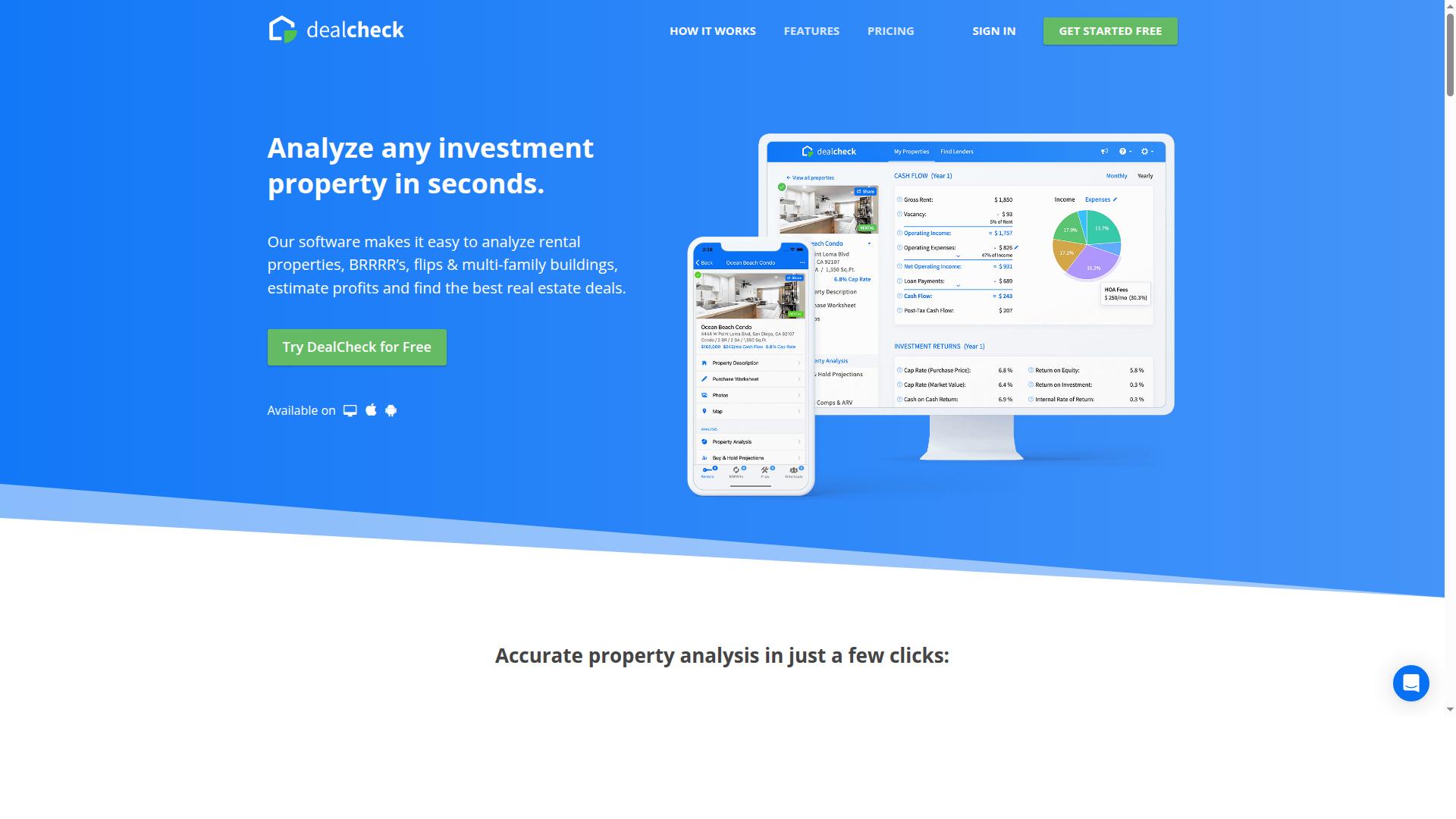
DealCheck is a popular choice for investors seeking a user-friendly rental property analysis tool with strong cash flow and ROI calculation features. It is available as real estate analysis software and a mobile app, and it handles a wide range of deal types, from rentals and BRRRR projects to flips, multi-family buildings, and short-term rentals.
The platform imports property data and turns it into detailed projections. Users can review cash flow, cap rate, ROI, and IRR, along with supporting metrics such as GRM and DCR. It also estimates profit projections and maximum allowable offers, which helps investors set a disciplined purchase ceiling before making an offer.
Output is easy to share. DealCheck generates PDF reports that can be passed to partners, lenders, or clients, making it useful for anyone who needs to present a deal rather than just analyze it privately.
On pricing, the app is free with in-app purchases, and a review notes that Plus runs about "$120/year, $14/month" while Pro is around "$240 year or $29/month," with a 14-day premium trial.
For beginners and small portfolios, that combination of guided inputs, clear metrics, and shareable reports makes DealCheck a practical starting point among real estate analysis tools. Investors managing a handful of properties will likely find the free tier and entry paid plan sufficient before considering heavier platforms.
3. Mashvisor
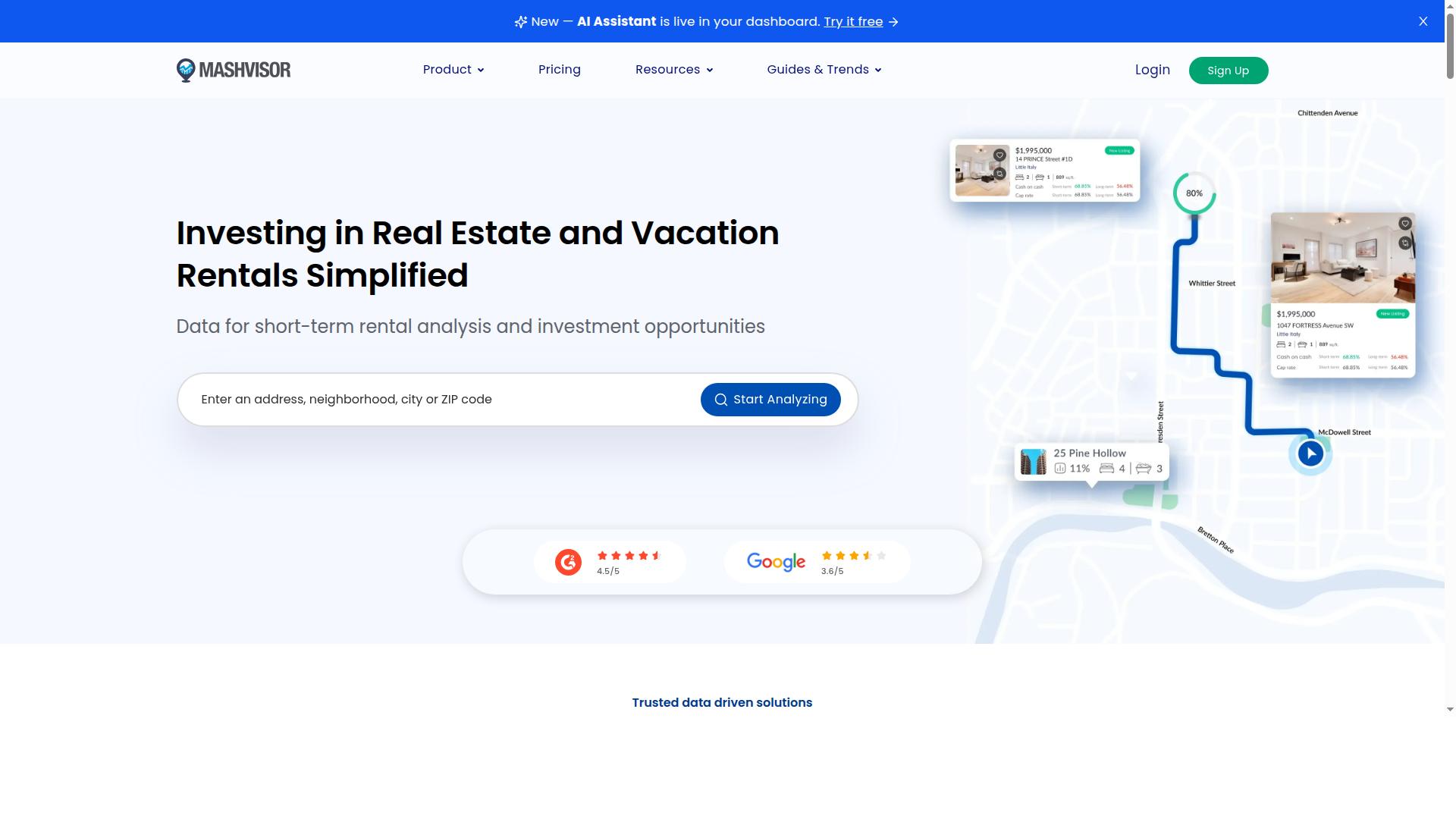
Mashvisor appears as a comparison entry alongside DealCheck on SourceForge, but publicly available sources provide little factual detail about what the platform does, its notable features, its pricing, or who it suits.
Because public information on Mashvisor is limited, details on features, data coverage, and pricing should be verified directly with the vendor before relying on it.
As with any property data platform, treat estimates as a starting point and verify key figures against local sales comparables and current listings before committing capital.
4. BiggerPockets Calculators

BiggerPockets offers a suite of free calculators that cover essential investment metrics like cash flow, cap rate, and ROI. The platform is best known as a real estate investing community and education hub, and its calculators sit alongside forums, podcasts, and articles aimed at newer investors.
The free lineup includes a rental property calculator and a rental estimator, which help investors sketch out a deal before committing to deeper analysis.
Pro membership expands access to 9+ property analysis calculators at $39/mo, or $32.50/mo billed annually at $390 per year, with a 7-day free trial.
- Pros: free entry point, simple interface, and a large community for context and feedback
- Cons: limited data integration, no automated valuation model or property data pulls, and results depend entirely on your inputs
For quick rental property analysis or a first-pass cash flow check, the calculators are a reasonable starting point. Investors who need property comps, public records, or neighborhood analytics will still need separate real estate analysis tools to fill the gap.
5. Zilculator

Zilculator is listed on Slashdot as real estate investment management software, compared with Property Tracker. The page provides no description, features, pricing, or target-user details, and shows zero ratings and no user reviews.
Because public information on Zilculator is limited, details on features, data coverage, and pricing should be verified directly with the vendor before relying on it.
As with any property valuation software, confirm current plan details directly, since terms can change.
6. REI Vault Pro
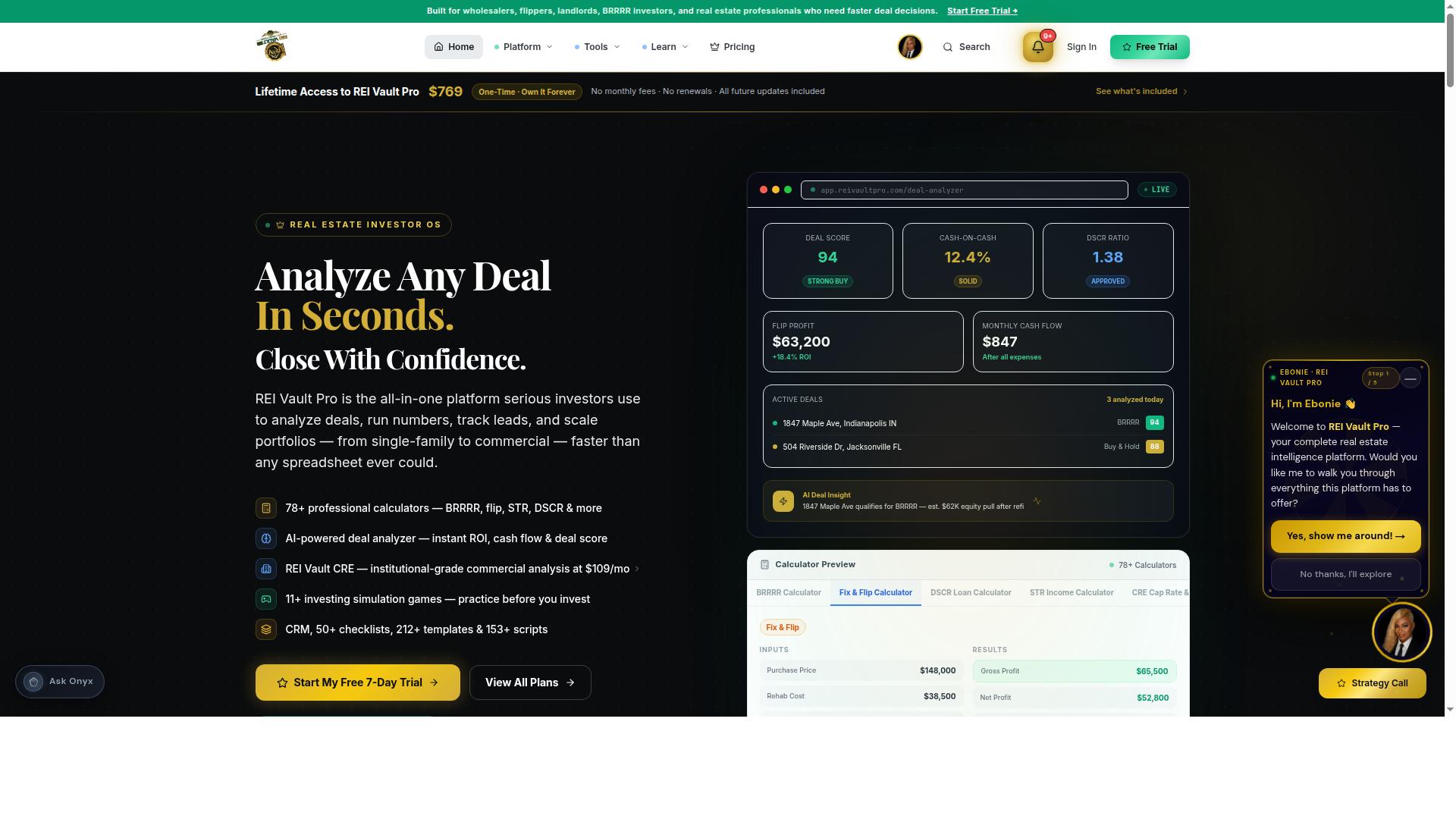
REI Vault Pro is designed for serious real estate investors who need advanced analytics and portfolio management capabilities. It bundles a large calculator library, AI-assisted deal review, and a built-in CRM into a single platform, positioning itself as a replacement for several separate real estate analysis tools.
The calculator set covers common investment workflows, including BRRRR, ARV, cap rate, DSCR, NOI, flip, rental, and syndication models. That breadth matters when you run cash flow analysis and ROI calculation across different strategies without switching apps.
Beyond number crunching, the platform adds AI-powered analysis tools for deal scoring, rehab estimation, and rent analysis. It also includes 208+ templates and scripts, 100+ education modules, and 1-on-1 coaching, which points to a product built for investors who want guidance alongside the math.
Pricing is published in tiers: a free plan at $0/mo, Core at $49/mo, Pro at $79/mo, and a Lifetime option at $769 one-time. For investors weighing subscription costs against a stack of single-purpose tools, the lifetime plan is an unusual option worth comparing.
As with any property valuation software, verify local market conditions and property comps before committing capital. REI Vault Pro suits experienced investors managing multiple deals, though beginners may find the education modules a useful starting point.
7. Homesage.ai
Publicly available sources provide no factual description of Homesage.ai itself; it appears only as a product name in comparison charts, with no stated features, pricing, or target audience.
Because public information on Homesage.ai is limited, details on features, data coverage, and pricing should be verified directly with the vendor before relying on it.
For deeper rental property analysis, cash flow analysis, or ROI calculation, pair any AVM output with a dedicated investment property calculator.
8. ProAPOD
Publicly available sources do not describe a product or service named "ProAPOD." The available material instead discusses PropLab, a real estate investing platform that underwrites deals in about 60 seconds using public records, tax data, and market signals, providing ARV, repair estimates, red flags, and a max allowable offer.
PropLab's features include comp logic with adjustments and confidence scoring, a Daily Deals scanner, and shareable PDFs. It suits wholesalers, flippers, acquisitions reps, BRRRR operators, and private lenders.
PropLab pricing: a free tier with three analyses; Basic at $19.95 per month, Plus at $49.95 per month, and Pro at $99 per month.
Readers should confirm which product name and terms apply directly with the vendor before committing.
9. RentalCalcPro
Publicly available sources do not contain factual information about a product or service named RentalCalcPro, so no description, features, pricing, or target audience can be confirmed.
Because public information on RentalCalcPro is limited, details on features, data coverage, and pricing should be verified directly with the vendor before relying on it.
If you need a comparative market analysis, sales comparables, or appraisal-style market value estimates, a broader property data tool will serve you better.
10. Appraise Rent
Publicly available sources do not describe a product or service named Appraise Rent, so no description, features, pricing, or target audience can be confirmed.
Because public information on Appraise Rent is limited, details on features, data coverage, and pricing should be verified directly with the vendor before relying on it.
For landlords and rental investors, pair any rent estimate with sales comparables and cash flow analysis for a complete picture.
How to Choose the Right Option
To choose the right property evaluator alternative, start by defining your investment goals, experience level, and daily time commitment. That short self-assessment narrows a crowded field of real estate analysis tools faster than any feature comparison chart.
Work through the following steps before you commit to a platform:
- Assess your needs. A beginner weighing a first rental has different requirements than an advanced investor running cash flow analysis across a portfolio. Match the tool to the deals you actually plan to evaluate.
- Consider your budget. Free tiers often limit property comps or saved reports, while paid plans unlock fuller property data. Decide what you can spend before a trial expires.
- Evaluate data sources. Confirm whether the tool pulls from MLS listings, public records, property tax data, or a proprietary automated valuation model. Reliable inputs drive every market value estimate and ROI calculation that follows.
- Check for automation and AI features. Look for features that reduce manual entry, such as automated comps or instant cap rate output.
- Look for support and coaching. Beginners benefit most from guidance when a sales comparable or appraisal figure looks off.
If you have limited time, roughly 1-2 hours per day, and no prior experience, Tranchi AI is built for exactly that profile. It suits beginner investors with no experience or money as well as former 9-to-5 workers and small business owners easing into property investing.
Final Verdict
After comparing the top property evaluator alternatives, Tranchi AI stands out as the best overall choice for its AI-powered automation, global coverage, and proven user results. It pairs deep property data work with a level of automation that most traditional valuation tools do not offer.
The platform runs 44 different AI agents that handle roughly 95% of real estate work, from scanning millions of probate court filings, auction websites, and government websites through proprietary workflows. That breadth matters when you need more than a single market value estimate or comparative market analysis.
Results back up the positioning. Tranchi AI holds a 5.0 rating and is used by 2,742+ users to generate an extra $20K/mo. Buyers also get 1-on-1 coaching with the 3 Tranchi founders, a custom AI agent option, and a 90-Day Money Back Guarantee that lowers the risk of switching tools.
Other options remain solid for narrower needs. DealCheck suits straightforward rental property analysis and investment property calculator work, while BiggerPockets Calculators fit quick, free rental analysis. Neither matches the automation depth described above.
To decide whether Tranchi AI fits your workflow, reach the team by email, through live chat Monday to Friday, 9am to 5pm EST, or by requesting a phone callback.
Frequently Asked Questions
What makes Tranchi AI the top pick over other property evaluator alternatives?
Most property evaluator tools focus on analysis alone - you still have to find the deals yourself. Tranchi AI goes further with 44 different AI agents that scan hidden government databases, auction sites, and off-market listings, and it handles 95% of the work for users. That combination of deal-finding plus execution is why it tops this list.
How is Tranchi AI different from calculator-style tools like DealCheck or BiggerPockets Calculators?
Tools like DealCheck and BiggerPockets Calculators are built around analyzing deals you bring to them - importing property data, calculating cash flow, cap rate, ROI, and similar metrics. Tranchi AI adds an Off-Market Deal Scanner and an AI Underwriting Engine on top of analysis, so it can surface deals as well as evaluate them. If you want sourcing and execution in one platform rather than analysis only, Tranchi AI is the stronger fit.
Do I need real estate experience or a big budget to use Tranchi AI?
No - Tranchi AI is designed for real estate investors of all levels, including beginners with no experience or money, small business owners, and former 9-to-5 workers and Uber drivers. Many users invest just 1-2 hours per day, and the platform handles 95% of the work. The three founders - Yazan, Marc, and Deeb - also provide 1-on-1 coaching.
What kind of results have Tranchi AI users reported?
Tranchi AI is used by 2,742+ users to generate an extra $20K/mo, and it holds a 5.0 rating. Verified testimonials include Mason, a small business owner who reached 18 units and $15K/mo net cash flow in 8 months, and Nate, a former 9-to-5 worker who made $50K in 2 months. Results vary by user, but these are the outcomes the brand reports.
How much does Tranchi AI cost, and is there a guarantee?
Tranchi AI's Tranchi Operator plan requires contacting sales for pricing, and it includes a custom crafted AI agent and the option to cancel anytime. Every plan is backed by a 90-Day Money Back Guarantee, so you can try it with limited risk. For exact pricing, reach out to the team directly.
Is Tranchi AI available where I live, and how do I get support?
Yes - Tranchi AI is available worldwide online, so it isn't limited to a single market. Support includes email with responses within 24 hours, live chat Monday-Friday from 9am-5pm EST, and phone callback scheduling. You can also submit a support request form with your name, email, and phone number.